Showing posts with label Pollution. Show all posts

Tuesday, 3 July 2012

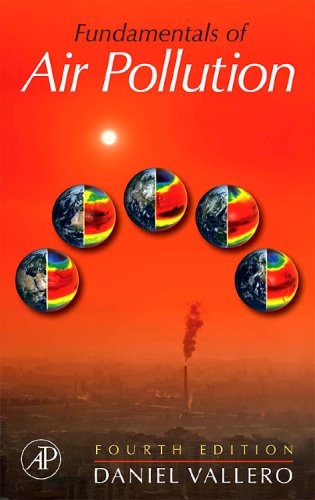
Fundamentals of Air Pollution

Fundamentals of Air Pollution
English | 2007-08-13 | ISBN: 0123736153 | 936 pages | PDF | 6,8 MB


Fundamentals of Air Pollution is an important and widely used textbook in the environmental science and engineering community. Written shortly after the passage of the seminal Clean Air Act Amendments of 1990, the third edition was quite timely. Surprisingly, the text has remained relevant for university professors, engineers, scientists, policy makers and students up to recent years. However, in light of the transition in the last five years from predominantly technology-based standards (maximum achievable control technologies or MACTs) to risk-based regulations and air quality standards, the text must be updated significantly.

The fourth edition will be updated to include numerous MACTs which were not foreseen during the writing of the third edition, such as secondary lead (Pb) smelting, petroleum refining, aerospace manufacturing, marine vessel loading, ship building, printing and publishing, elastomer production, offsite waste operations, and polyethylene terephthalate polymer and styrene-based thermoplastic polymers production. Overall, revisions will reflect the numerous changes in the understanding of air pollution and the development of new technologies that has occurred in the past twelve years.


Depositfiles

Wednesday, 2 May 2012

Ecology of Industrial Pollution

Ecology of Industrial Pollution
Cambridge University Press; 1 edition (March 31, 2010) | ISBN: 0521514460 | 362 pages | PDF | 5 MB

Written for researchers and practitioners in environmental pollution, management and ecology, this interdisciplinary account explores the ecological issues associated with industrial pollution to provide a complete picture of this important environmental problem from cause to effect to solution. Bringing together diverse viewpoints from academia and environmental agencies and regulators, the contributors cover such topics as biological resources of mining areas, biomonitoring of freshwater and marine ecosystems and risk assessment of contaminated land in order to explore important questions such as: What are the effects of pollutants on functional ecology and ecosystems? Do current monitoring techniques accurately signal the extent of industrial pollution? Does existing policy provide a coherent and practicable approach? Case studies from throughout the world illustrate major themes and provide valuable insights into the positive and negative effects of industrial pollution, the provision of appropriate monitoring schemes and the design of remediation and restoration strategies. 


Friday, 2 December 2011

Solid Waste: Assessment, Monitoring and Remediation, Volume 4


Solid Waste: Assessment, Monitoring and Remediation, Volume 4
Pergamon; 1 edition | May 6, 2004 | ISBN-10: 0080443214 | 1222 pages | PDF | 60 Mb


This book covers a broad group of wastes, from biowaste to hazardous waste, but primarily the largest (by mass and volume) group of wastes that are not hazardous, but also are not inert, and are problematic for three major reasons: (1) they are difficult to manage because of their volume: usually they are used in civil engineering as a common fill etc., where they are exposed to environmental conditions almost the same way as at disposal sites; (2) they are not geochemically stable and in the different periods of environmental exposure undergo transformations that might add hazardous properties to the material that are not displayed when it is freshly generated; (3) many designers and researchers in different countries involved in waste management are often not aware of time-delayed adverse environmental impact of some large-volume waste, and also do not consider some positive properties that may extend the area of their environmentally beneficial application.